
Volume 103: What Ruth Shaber Can Teach Any Investor About Demanding Change From the Finance Industry
ImpactPHL Perspectives explores the many facets of the impact economy in Greater Philadelphia from the perspectives of its doers, movers, shakers, and agents of change. Each volume shares best practices and lessons learned while challenging our assumptions about financial and impact returns. For more perspectives, check out the full catalog of ImpactPHL Perspectives.
Ruth Shaber’s first experience with impact investing was the lack of it.
During her 25-year career as an OBGYN and senior executive at Kaiser Permanente, she saw how inadequate investment in innovation, research, and policy change affected patient health.
“By the end of my medical career there, I had a better appreciation for the importance of capital in system change and outcomes,” Ruth says.
A brief stint as a program officer at a large foundation sharpened her trajectory, exposing Ruth to the disconnect between how foundations implement their programs and grant giving and how they approach their investment strategies.
“It was so clear to me that foundations that only give away 5% of their corpus and invest 95% in traditional methods are going to do a lot more damage than good.”
“It was so clear to me that foundations that only give away 5% of their corpus and invest 95% in traditional methods are going to do a lot more damage than good,” Ruth explains. “Without a market solution to the problem you're trying to solve, you're not going to ever get systemic change.”
Ruth wanted to make a larger impact, and felt clear that money was at the center of that. But she wanted to approach it differently than the typical philanthropic organization.
So Ruth started the Tara Health Foundation in 2014 with a vision of working towards gender, economic, and racial justice through the creative use of capital — and started diving deep into the world of impact investing.
In the years since then, she’s pioneered innovative ways to put money towards the causes she cares about. Over the past decade, Tara Health Foundation has deployed $100+ million through grants, investments, loans, and creative capital, all 100% mission-aligned. They’ve used their grantmaking dollars to fund research to advance the field of gender-lens investing, and to help build tools like the Gender Equality Funds tool. They launched Rhia Ventures and its investment arm, RH Capital, one of the first venture funds dedicated to women's health, and Orchid Capital Collective, which leverages integrated capital to invest in community-owned ventures that anchor economic development with transformative birth and reproductive care. They built a shareholder coalition, now representing roughly $500 billion in assets, that presses public companies on issues like health benefits and reproductive privacy.
Yes, Ruth has been fortunate to have large sums to work with in support of her mission — but her advice to others looking to make an impact is surprisingly accessible to investors of any stripe.
Start with the people who have gone before you
At the start of Ruth’s foray into impact investing, she leaned heavily on finding inspiration from other thinkers in the space, either by reading their work or connecting with them directly.
She points to impact investing leaders like Antony Bugg-Levine, Judith Rodin, Clara Miller, and Jackie VanderBrug as being especially influential in shaping her thinking and belief in what’s possible.
“I gathered these authors and individuals around me that put a lot of wind in my sails,” she says, adding that there’s a lot of value in a community like ImpactPHL for finding these types of helpful connections.
Get creative with investing based on your values
When Ruth first set out to invest Tara Health’s money in service of the foundation’s mission, there was no obvious path forward. “There wasn't a portfolio model out there, so we had to build it,” Ruth shares.
“They never said, ‘This is stupid, let's just make as much money as we can so you'll have more to give away,’” Ruth shares. “They were all in.”
Initially, her team considered moving some of their money out of Merrill Lynch — where they were investing at the time — in to a more boutique impact investing firm. But her longtime advisors at Merrill Lynch made a different offer: stay, and build the strategy together. “They never said, ‘This is stupid, let's just make as much money as we can so you'll have more to give away,’” Ruth shares. “They were all in.”
Even with her advisors at her side, there were no tools to easily assess the social impact of different companies. Ruth says they were often left to “make stuff up” — getting creative and finding proxies for the values they cared about. For instance, they wanted to invest in companies that cared about reproductive health, so decided to look for companies that donate to Planned Parenthood as a surrogate indicator that the company cares about women.
Today, thanks to the work of Ruth and others like her, more off-the-shelf tools exist that make it even easier to achieve mission-aligned investing, like the Invest Your Values toolkit. At a minimum, Ruth suggests every investor ask their advisors to run their mutual funds through the toolkit and see how they score. “It’s such an easy lift,” she says.
Another useful heuristic they found: The gender and racial makeup of their fund managers. A 2022 Vanguard study found that funds managed by mixed-gender teams far outperformed homogeneous ones. And through Ruth’s own work with The Diverse Investing Collective, they’ve found that, when people with different lived experiences are sitting in the asset allocation seat, there’s better financial returns and social impact.
“Just like we talk about diversifying our portfolios, if you diversify the people making this decision on your behalf, you're going to get stronger outcomes,” says Ruth, encouraging investors at any level to ask their bankers for a demographic breakdown of their fund managers.
This experience has made it clear to Ruth that investing with impact in mind doesn’t have to mean risking your returns. “We made a ton of money, despite our constraints. It was not really in spite of but because we were gender aligned that we outperformed the market,” Ruth explains. It’s what inspired the book she co-authored, The XX Edge: Unlocking Higher Returns and Lower Risk.
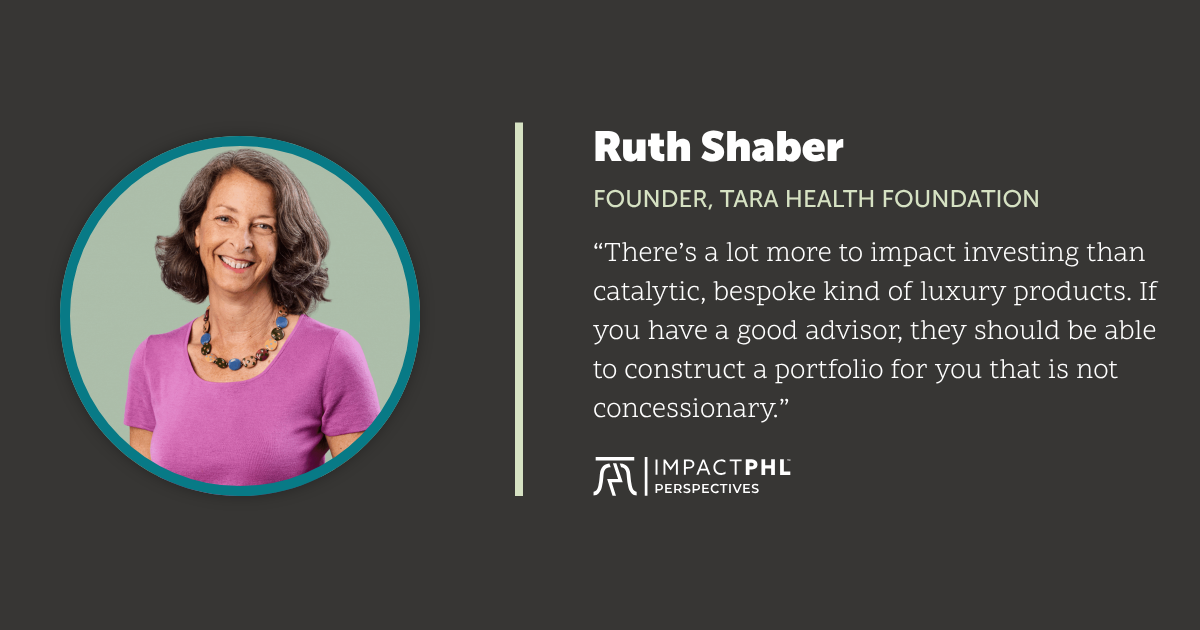
“There’s a lot more to impact investing than catalytic, bespoke kind of luxury products,” Ruth adds. “If you have a good advisor, they should be able to construct a portfolio for you that is not concessionary.”
Demand more from our financial systems
“If you have a good advisor, they should be able to construct a portfolio for you that is not concessionary.”
Ultimately, Ruth doesn’t think this kind of collaborative relationship with investors and their financial institutions need be reserved for people who have a foundation’s worth of assets.
“I think that we need to take control back from the finance industry,” she says.
Too many people, she believes, accept an opaqueness around their own money that shouldn’t exist. “We as asset owners, no matter how much you have, need to start asking for transparency,” she says.
Demanding transparency — and more of the types of investments you want — is what it will take to see more opportunities for impact become available. “We didn't get organic food in the grocery store until customers came in and started asking for it. It’s up to us to do that. They’re only going to meet our demand,” says Ruth.
And remember, all of these tools and tactics are in service of you being comfortable taking the most important step in impact investing: keeping your money flowing. It’s why Ruth, with the help of the systems she’s built over the past decade, is spending down Tara Health’s full endowment by 2028, rather than letting it sit in perpetuity. “We all know that money needs to move,” shares Ruth. “Hoarding assets, keeping them out of play, isn't going to help us meet our goals.”
Article by Erin Greenawald.