
Volume 106: How impact investors catalyzed $141M in wages to Pennsylvanians facing barriers to employment
ImpactPHL Perspectives explores the many facets of the impact economy in Greater Philadelphia from the perspectives of its doers, movers, shakers, and agents of change. Each volume shares best practices and lessons learned while challenging our assumptions about financial and impact returns. For more perspectives, check out the full catalog of ImpactPHL Perspectives.
Karima Rose’s career has weaved and bobbed through agricultural science, nutrition education in Philadelphia schools and workforce development.
Looking back over the last 25 years, Karima pinpointed the connective tissue between these different roles and industries: empowering people with knowledge to help change their lives for the better.
While knowledge is certainly power, an important piece was often missing from the puzzle — money — to give people the resources necessary to make these big changes.
“I spent all of this time empowering people with knowledge, but if you don't have money, what good is the knowledge?” Karima says.
This light-bulb moment led Karima to join First Step Staffing, a nonprofit that has helped people facing barriers to employment since 2007, with its Philadelphia office opening in 2018. As the senior vice president of mission services, Karima is based in Philadelphia and works with team members across the eight cities the organization serves to keep clients working, along with building community and charitable partnerships.
In this role, Karima has finally been able to blend knowledge-sharing with the appropriate funding and investments to make a real impact here in Philadelphia, and across the country.
Helping those who have constantly been told ‘no’ receive a life-changing first ‘yes’
First Step Staffing was founded in Atlanta by the late Greg Block on the idea that individuals experiencing homelessness often need just one thing: an opportunity — not a handout — to rebuild their lives.
“Greg wanted to take the dollars he had earned as a very successful businessman to give back,” Karima shares.
Using his business expertise — and zest for getting people to say yes — Greg opened a staffing agency where he contracted jobs and gave them to the people who needed them the most.
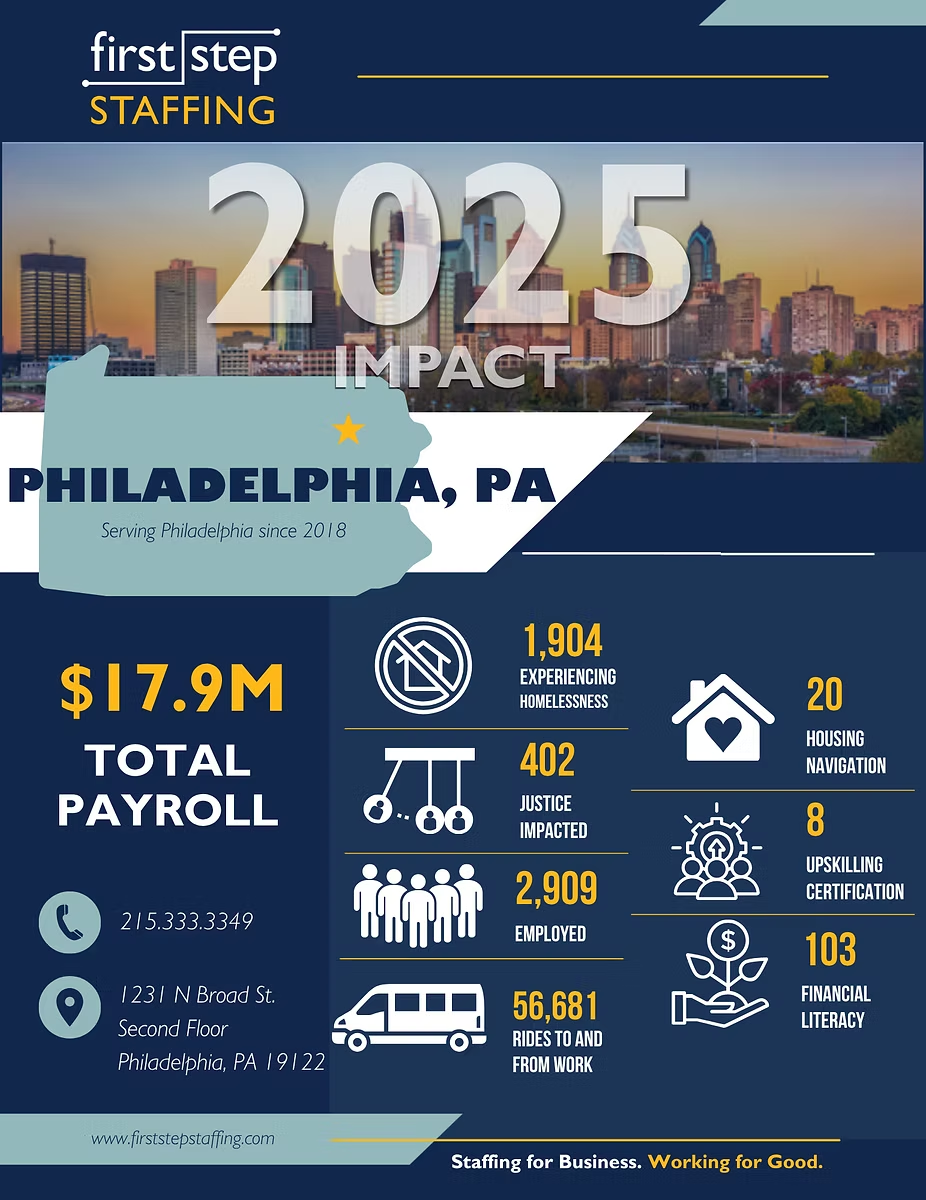
First Step Staffing by the numbers:
56,540+ workers employed.
$366 million+ wages earned.
719,000+ rides to work.
“We became a nonprofit staffing agency where we open up doors and pathways to economic stability for those shut out of the workforce,” Karima explains, noting the clients they help may not have stable housing or transportation, or have had past experiences with the justice system that prevent them from finding steady employment.
“We serve people who have attempted to get jobs on their own and they were constantly told no,” Karima says. “At First Step, they finally get their first yes.”
Here’s how it works: First Step “de-risks” the employment process for their partners. They contracted jobs and hire and train employees to be successful in their new roles. In addition to connecting people to employment, First Step helps them with transportation to and from work, and anything else they may need to be successful in this new role.
“We are the employer,” Karima says. “We hold the insurance, workers compensation and liability. Everyone is paid under First Step and we place them at the jobs we have contracted with in various markets.”
The jobs First Step provide typically fall within the light industrial category — everything from food services, packing, shipping, loading, logistics, transportation, cleaning and hospitality.
But more than offering a job, First Step Staffing gives the people it serves something intangible: a much-needed vote of trust and confidence that has the power to change the life path for an individual and their family.
An investment that actually changes lives and communities for the better
First Step isn’t your typical nonprofit agency that relies solely on charitable dollars.
“We thrive and survive off of earned revenue,” Karima explains. “It’s the markup we charge employers when we purchase or contract with them for jobs. That markup is invested back into our population to offer support, including transportation, uniforms, PPE and anything else required.”
First Step also relies on investments from people in the community.
This is not philanthropy. When someone invests in First Step Staffing, they’re not only earning interest, they are truly changing the lives of Philadelphians.
When the organization expanded into its second city — Philadelphia — Greg made contact with potential investors by connecting with ImpactPHL who made an important introduction to members of Investors’ Circle, a group of investors that allocate money to social enterprises.
A $7 million capital investment from individuals involved in Investors’ Circle helped to open the doors of First Step’s Philadelphia office (along with capital from the NonProfit Finance Fund and a grant from the Barra Foundation and Samuel S. Fels Fund). Eight years later, First Step has used that initial investment to employ more than 21,000 individuals in the city and pay out over $141 million in wages in Pennsylvania.
This is not philanthropy. When someone invests in First Step Staffing, they’re not only earning interest, they are truly changing the lives of Philadelphians who need a little extra support, and boosting the economic climate of the city.
“By doing so, you're increasing the number of people employed, decreasing those who are struggling to make ends meet and giving new opportunities to others that typically they would not have,” Karima explains.
A perfect pairing: financial capital + human capital
Here in Philadelphia, First Step Staffing’s investors have proven to be passionate about the cause.
“Our investors are more than someone who provided financial capital; they provide human capital through their volunteer of time, their volunteer of feedback and their network of connections,” Karima says.
This level of commitment helps First Step internally grow and develop their staff, but also better serve the individuals in the community they employ.
Investor and national board member Leigh Wood comes to mind as an example of an investor whose commitment goes beyond a dollar amount.
Leigh spends time in the First Step office connecting with the people the organization serves, spending hours talking to them and listening to their stories. She travels to events in other First Step cities and chats with staff members to see what other resources they might need to make an even bigger impact.
“First Step definitely has the best pack of investors. They are true champions,” Karima shares. “If you want to be amongst some of the most giving people who not only have done well in their lives financially, but have a core connection to a social responsibility, organizations such as First Step is definitely a way for investors to connect with other like-minded individuals to do that work.”
Start with — and stay centered — on the why
Karima has some sound advice for those looking to invest in causes that mean something to them and their communities: start with the why.
“Profit will come as long as you stay centered on the why,” she says. “Look at the purpose of the existence of the organization and what they’re trying to accomplish.”
One impactful way to do this is by spending time talking to the people the organization serves.
“Profit will come as long as you stay centered on the why.”
“This gives you a perspective that a paper application or a conversation with the company’s executives will never be able to,” Karima shares.
Taking the time to speak with someone who has been impacted by the organization directly — one of the folks who have been placed into a job — can help a potential investor truly decide if the “why” of this organization matters to them.
Karima flips the ‘why’ question on its head: why not invest?
An investment in First Step Staffing means that someone sees the value in not giving up on an untapped population that can change the economic climate of Philadelphia, stabilize and expand the housing market and potentially become future leaders of the city.
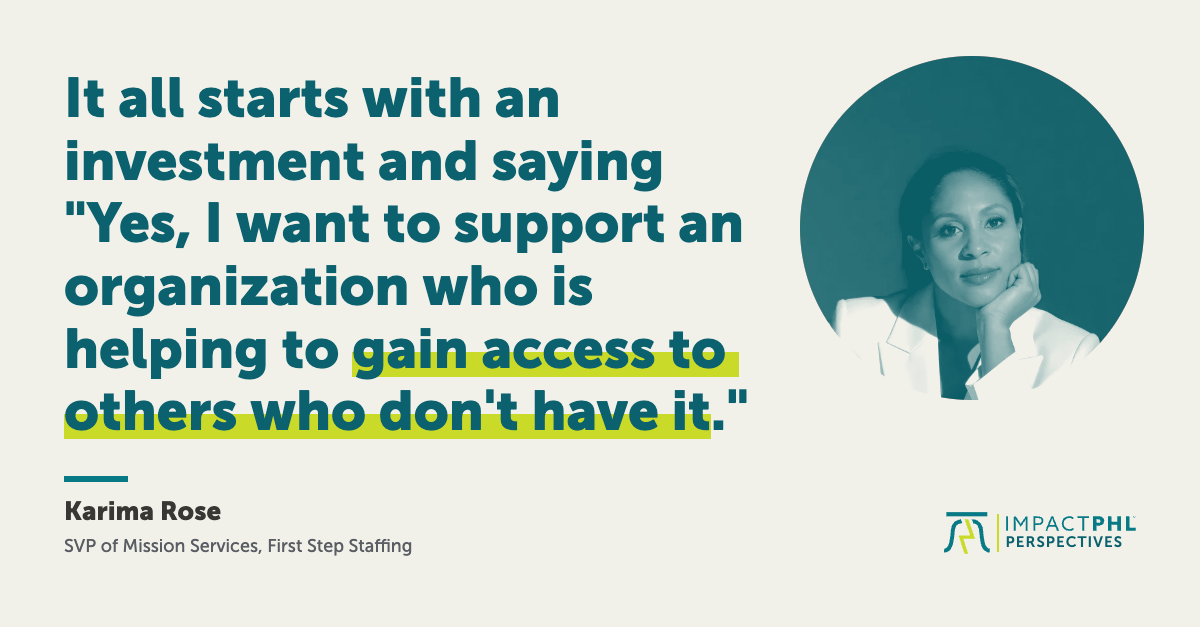
“It all starts with an investment, and by investing and saying yes, I want to support an organization who is helping to gain access to others who don't have it — that's where your dollars ultimately can land,” Karima says.
Written by Jessica Lawlor.