
Volume 107: Why Judy Wicks Doesn't Invest a Dime of Her Money with Wall Street
ImpactPHL Perspectives explores the many facets of the impact economy in Greater Philadelphia from the perspectives of its doers, movers, shakers, and agents of change. Each volume shares best practices and lessons learned while challenging our assumptions about financial and impact returns. For more perspectives, check out the full catalog of ImpactPHL Perspectives.
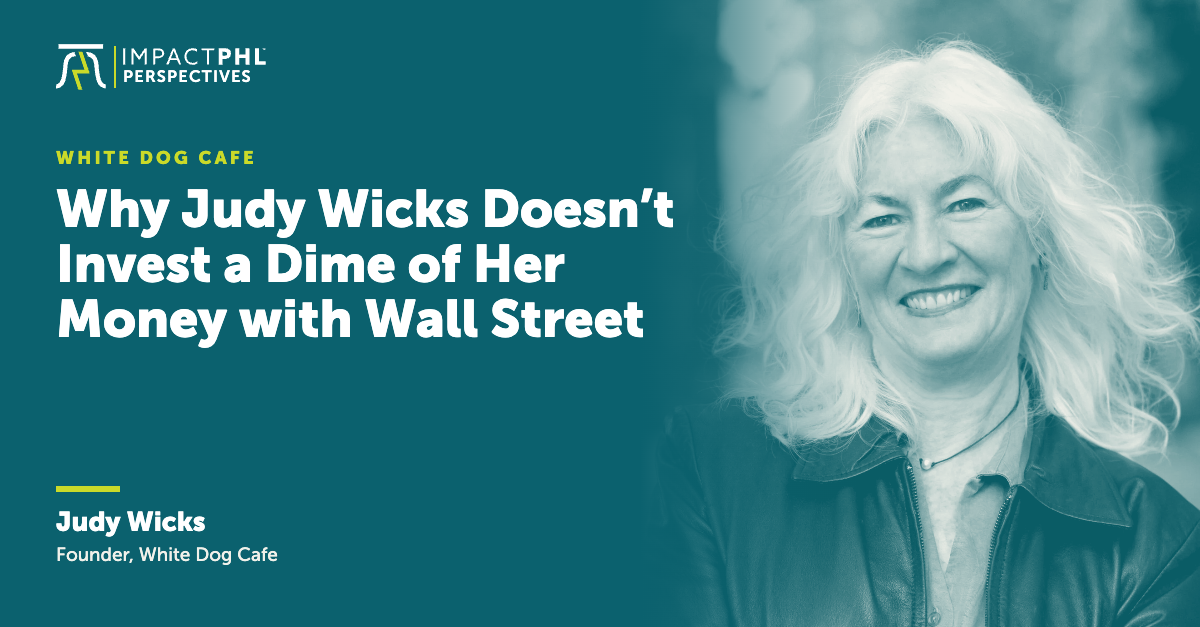
When it comes to investing in local economies, Judy Wicks is a bit of a Philadelphia legend.
Her impact started when she opened the White Dog Cafe in 1983, after helping save her block of West Philadelphia brownstones from being torn down for a mall of chain stores. The restaurant became a leader in the local food movement, paid a living wage, and was the first business in Pennsylvania to buy all of its electricity from renewable sources.
She also put the restaurant’s success back into the community. Twenty percent of White Dog’s profits helped support Fair Food Philly, which Judy founded to connect local family farms with the city’s restaurants and markets, and the Sustainable Business Network of Greater Philadelphia, which she founded to support locally owned businesses committed to sustainability. She also cofounded the Business Alliance for Local Living Economies, now called Common Future, which directs capital to Black-owned businesses and the nonprofits that serve them.
After selling the restaurant in 2009, Judy kept going. In 2015, she started the Circle of Aunts & Uncles, a microloan fund for local entrepreneurs without family money to get started. In 2019, she founded All Together Now Pennsylvania to help build self-reliant regional economies, which now operates as PA Fibershed and focuses on building a sustainable regional textile industry.
It’s clear Judy has had massive local impact through her work. What’s less widely told is how that same thinking guided what she’s done with her own money over the years. Read on to learn more about Judy’s bold investment choices — and why she didn’t think there was really a choice at all.
Impact investing before it was cool
“Simply by investing in the stock market, you're perpetuating a system that puts profit above people and the environment.”
Admittedly, Judy has never had a lot of spare money to invest outside of her businesses. “I never really had much to invest or to save because, as an entrepreneur, I always put my money into my business,” she explains.
One notable exception, however, was the inheritance she received from her parents in the form of a stock portfolio. Judy was immediately against the idea of keeping it there.
“I wanted my money to do something good,” she explains. “I did not want my money to make Pepsi or Exxon richer. Who would want to do that?”
She briefly explored moving that money into socially responsible funds within the stock market, but ultimately decided that still wasn’t fully aligned with her values. “I feel like corporate globalization is the biggest threat to the world,” she shares. “Simply by investing in the stock market, you're perpetuating a system that puts profit above people and the environment.”
Unfortunately, at the time, there weren’t a lot of other options. The impact investing space was much less developed than it is today, and it wasn’t clear how Judy could put her money towards her community. Then, a friend told her about Reinvestment Fund, a Philadelphia-based organization that takes money from investors — as little as $1,000 for a minimum 3-year term — and lends it to projects that build stronger, more equitable communities.
Judy was all in, putting 100% of her inheritance into the Reinvestment Fund.
“You're not supposed to put all your eggs in one basket. But I did, because I couldn't find any other place to put it,” she says. Judy was pleased to see her money going towards affordable housing, local grocery stores, and renewable energy development in her local community. Later, she added money to Regenerative Social Finance, which invests in community programs like biodynamic farms and Waldorf schools.
Her friends thought she was making a terrible decision, but for Judy, it felt like there wasn’t a decision at all. “I don't really have a choice, because I have to live by my values, and I don't value publicly traded companies — I don't want to support that,” she shares.
Judy felt her financial return was enough for what she needed and the community return was more than worth it.
“When you invest locally, you're getting a double return,” she explains. “You're getting your financial return, but you're also living in a community that’s more prosperous and fun and safe.”
Making investment decisions for by stronger communities
Judy’s investment decisions have been guided by a core belief that the way most people think about investing is backwards.
“When you invest locally, you're getting a double return.”
“The basis of the problem is that people make decisions based on money instead of making decisions based on the well-being of people and nature,” she explains.
That doesn’t make her anti-business, and she’s quick to say so. “I’m not a communist. I’m a capitalist. I’m a business owner,” she says. “I understand the beauty of free enterprise, but it’s about free enterprise for the benefit of all, creating companies that serve nature and serve other people, not drain them.” That’s the basis of impact investing: Making business decisions that center the welfare of others.
She also thinks about return on investment on a longer timeline than most. Judy points to the idea of weighing decisions by their effect on the seventh generation, a principle she attributes to Native American communities. “If we want our grandchildren to survive, we need to be planning for them now,” she says, urging people to consider how their investments will affect future generations.
“It's not about making them richer in terms of money,” she adds. “It's about protecting the world that they are being born into.”
To her, that means investing into projects that will help build sustainable, self-reliant local economies — organizations supporting local food systems, building materials, clothing, energy, plant medicine, or anything else communities need to survive and thrive.
For anyone wondering where to start, she suggests looking at what your community needs. “Research: Where does my community get basic needs right now? Where does the food come from? Where does the energy come from? And see if there's investment opportunities in those areas of self-reliance,” Judy suggests.
She’s not suggesting everyone has to go all in like she did to make a difference. “Stick your toe in the water,” she urges. “I think everybody should try impact investing and see how it makes them feel knowing they’re investing in something their community actually needs.”
A hyper-local investment for her last chapter
Now nearly 80 years old, Judy’s investments have become hyper local, with everything going into the two acre property where she lives.
Everything about “The Homestead,” as she’s named it, is geared towards resilience and community. They leveled off a hill to create the “party plateau,” where Judy has hosted community events and progressive political fundraisers for up to 250 people. They have a meadow of native flowers, fruit and nut trees, and a vegetable garden. The Homestead runs on solar power, a continuation of Judy’s renewable energy commitment.
“We're creating a paradise here,” Judy says, adding that her relationship to community has always been rooted in a place to gather people.
The payoff, she says, is the same as with every other choice she’s made about her money. “You sleep better at night when you align your values with your investments,” says Judy. “You’re supporting the world you want to live in. To me, it’s like coming to your senses.”
Article by Erin Greenawald.