
Volume 99: “Do I owe anything back to Philadelphia?” How Pitou Devgon Keeps Capital Local
About ImpactPHL Perspectives:
ImpactPHL Perspectives explores the many facets of the impact economy in Greater Philadelphia from the perspectives of its doers, movers, shakers, and agents of change. Each volume shares best practices and lessons learned while challenging our assumptions about financial and impact returns. For more perspectives, check out the full catalog of ImpactPHL Perspectives.
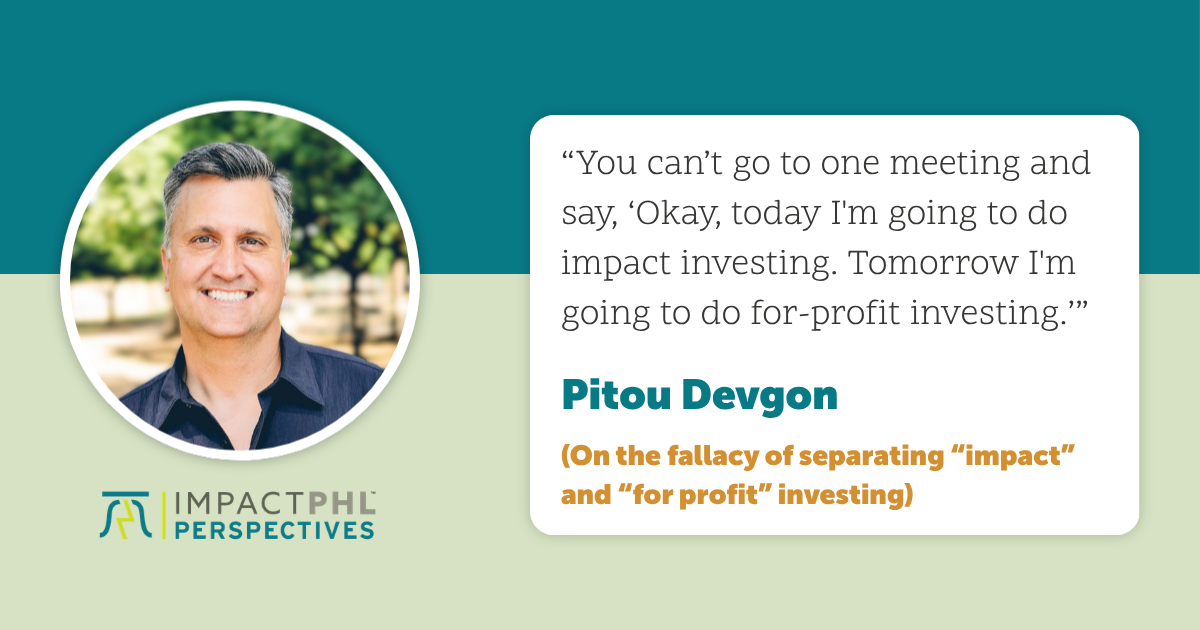
Pitou Devgon believes it’s a disservice to use the term “impact investing.”
Here’s why: it doesn’t encapsulate the full scope of what he and many other investors are aiming to achieve with their investments.
With a unique blend of experience as a doctor, angel investor, venture capitalist, and healthcare entrepreneur, Pitou prefers to think about his strategy as investing with intent — “it’s just early-stage investing, but with a more thoughtful, broader scope,” he explains.
Becoming an accidental venture capitalist turned founder
Pitou came to Philadelphia in 2005 to complete his internal medicine residency at the Hospital of the University of Pennsylvania. Two decades later, he still calls Philly home and has built a family and life here. Pitou’s winding career path started in healthcare venture capital, evolved into co-founding a company of his own, and these days he works as an angel investor and advisor helping grow many successful businesses in the city.
During his residency, Pitou began gravitating toward the technology side of healthcare.
“I love building things,” he says, so he pivoted and enrolled in Wharton’s healthcare program where he earned his MBA focused around healthcare entrepreneurship.
Pitou started his career in healthcare venture capital at a half-billion dollar fund called Safeguard Scientifics, one of the only funds hiring back in 2010 after the housing bubble collapsed.
“I spent four years as an accidental venture capitalist,” Pitou explains. “I wasn't trying to be a VC; that wasn't my goal, but it was actually a blessing in disguise.”
Pitou wanted to be an entrepreneur and builder, but his time at the fund gave him a front row seat to the investor side, analyzing hundreds of early-stage healthcare companies where he learned to think like an investor.
While working as a VC, Pitou kept his clinical skills sharp, practicing medicine part-time as a hospitalist in the Medical ICU at the VA Medical Center next door to Penn.
Working on a deal at the investment fund late one night, his boss and mentor noticed he was distracted. Pitou had been thinking about a product idea he had while caring for a patient.
The boss offered up an interesting deal: "Look, I'll give you $10,000 and be your first angel investor,” he said. “Then, I’ll fire you in six months. That way, it’ll force you to actually work on it.”
This first investment lit a fire under Pitou, and he joined forces with co-founder Eric Stone and got to work building Velano Vascular, which developed the PIVO™ Pro Needle-Free Blood Draw Device to make drawing blood in a hospital setting pain-free and more efficient.
Eight years, millions of procedures, and four FDA clearances later, Pitou and his co-founder had raised $40 million and built a team of 50 people in Philadelphia and San Francisco. In 2021, Velano Vascular was successfully acquired by Becton Dickinson, the world’s largest medical products company.
Aligning investments with values
After a successful exit, Pitou found himself at a crossroads: How do you bring purpose back to your life when you don’t have an obvious purpose anymore?
“It's a very strange event to have your company acquired, and then your life kind of changes, literally from one day to the next,” he says. “You wake up in the morning and you don't have a job, and you have some extra money in your bank account.”
Pitou started to wonder if he should do things differently with the extra resources he had acquired. After checking various boxes — upgrades to the house and car, money for the kids’ education, long-term investments — Pitou realized there was a box unchecked.
“Do I owe anything back to Philadelphia and to all the different places that helped me get to where I am?” he asked himself.
“Do I owe anything back to Philadelphia and to all the different places that helped me get to where I am?”
While Pitou believes there’s a time and place for donations, he prefers to live by the old adage of teaching a man how to fish rather than simply giving him a fish. He determined the best way he could help was through the same engine that built his company: investing his money, time, and expertise to help build interesting businesses making a difference in the city and beyond.
A conversation with ImpactPHL’s co-founder & SVP of community engagement Cory Donovan shifted Pitou’s mindset. Cory asked Pitou if he knew where his money was being invested. Had he ever had a conversation with his financial advisor about his values and aligning his investments more closely?
“That was the first aha moment for me,” he says, and scheduled a meeting with his financial advisor to comb through his portfolio and make some changes. Pitou and his advisor aligned on which sectors he was investing in, but also geography. He wanted to slowly shift more of his investments to align with his values and to support more Philadelphia-based businesses.
A second aha moment was attending the ImpactPHL Total Impact Summit.
“Being exposed to a whole new ecosystem of impact investors and organizations and foundations that are trying to improve the world was really inspiring,” Pitou says.
No label needed: Investing as a whole person
Armed with this new knowledge, Pitou focused his efforts on early-stage investing, joining Robin Hood Ventures, a leading Mid-Atlantic angel investment group.
He felt a brand new freedom around investing.
“Going from a completely returns-driven investing mindset as a prior professional investor, and then going through the entrepreneurial journey, and now on the other side, popping out as an angel investor, I can make my own decisions and invest in whatever I'd like,” he says.
While Pitou doesn’t label himself as an impact investor, he evaluates investment decisions through a lens he hadn’t been able to consider earlier in his career.
“I'm investing to build healthcare companies with high growth founders, but I also can ask: are some of these [investments] potentially impact-focused?” he explains. “I'm an angel investor that also thinks about those factors as part of that decision calculus.”
While Pitou first and foremost looks for smart teams with innovative ideas, his favorite investments focus on supporting:
Young, first-time entrepreneurs.
Those with diverse backgrounds — 40% of his portfolio are female CEOs.
Companies in the Greater Philadelphia area.
“I realized one of the biggest things I could do for impact is support her and invest in her company.”
An investment Pitou is particularly proud of is his work with Hanimune Therapeutics, a Philadelphia-based, female-founded biotech company focused on preventing and treating childhood food allergies. Founded by a former colleague, Meenal Lele, Pitou felt a particular pull to get involved when his own child began experiencing food allergies.
“I realized one of the biggest things I could do for impact is support her and invest in her company,” he says. “It was a triple win for me: she’s in Philly, it’s a healthcare company, and she’s solving for something that, if successful, will give my kid and other kids a better outcome.”
Pitou put his time and money where his mouth is and joined the advisory board and helped Meenal raise her seed round, with much of the funds coming from his angel group — Robin Hood — and other funders in the Philly area.
Another notable investment is Pitou’s involvement with Vytala, a Philadelphia-based FoodTech company dedicated to advancing nutrition through innovative solutions.
He also invests in The GO PA Fund (part of Ben Franklin Technology Partners), which invests in technology-based ventures throughout the Commonwealth of Pennsylvania.
“The dream is you create a virtuous cycle where I invest at an early stage when it's one or two people in a garage on the angel side through Robin Hood, and then as they scale and grow, then they receive their next round of capital from the GO PA Fund,” Pitou says. “And then they go off to raise more money or they become profitable, and they hopefully stay in Philly. That would be the ideal scenario for our local ecosystem.”
Because the line between business and personal interests naturally blur, Pitou prefers to look at potential investments as a whole person. He says it’s a misconception to think of impact investing as a separate category of investing.
“You can’t go to one meeting and say, ‘okay, today I'm going to do impact investing. Tomorrow I'm going to do for-profit investing,’” he explains. “A lot of the deals we see are really mixed.”
When you start to think of impact investing as an overall philosophy of investing with intent and aligning with your values, that’s where you can really start to make a difference.
Written by Jessica Lawlor.