
Volume 100: Homer Robinson's Playbook: Pick a Theme, Find Your People, Put Your Capital to Work
ImpactPHL Perspectives explores the many facets of the impact economy in Greater Philadelphia from the perspectives of its doers, movers, shakers, and agents of change. Each volume shares best practices and lessons learned while challenging our assumptions about financial and impact returns. For more perspectives, check out the full catalog of ImpactPHL Perspectives.
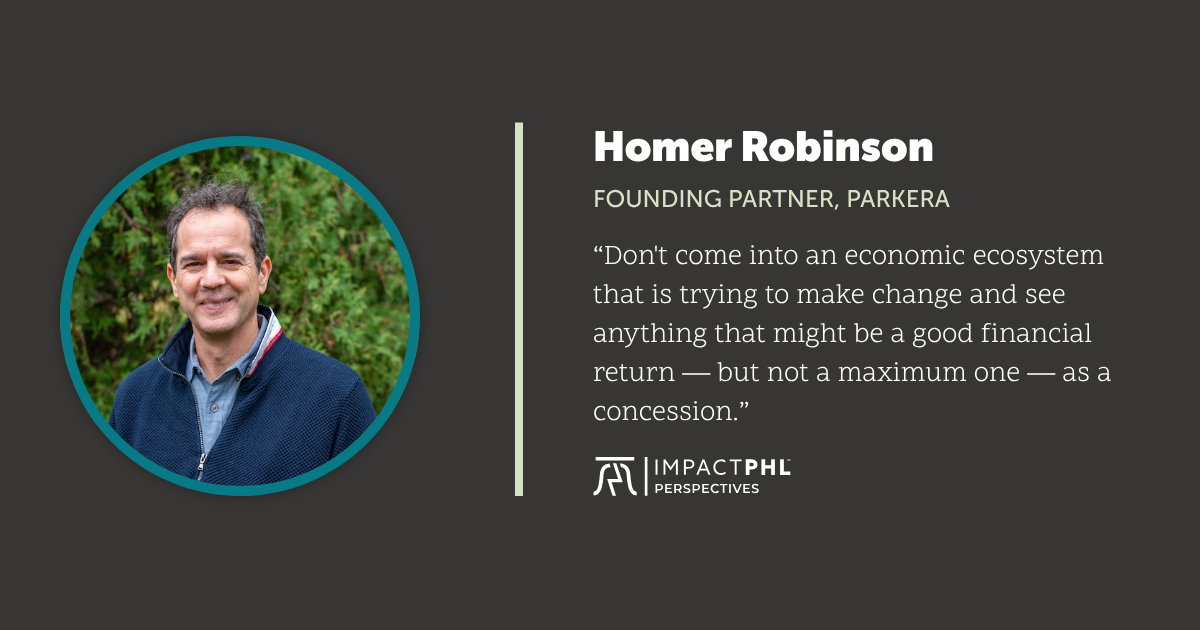
Having kids completely changed how Homer Robinson thought about investing.
Before that, he was not, by his own admission, a particularly conscious investor. He had some money to work with, thanks to his family's successful real estate company that he took over in 2012. He had a target-date 401(k). He had some private investments that a third party managed. He and his wife had screened out a few things they didn't want to support, such as firearms and private prisons, and then mostly stopped thinking about it.
His first son's arrival reframed what he wanted his money to do. First, he wanted it working towards improving the future his children would inherit.
"I felt really motivated to do something about climate change for the first time," he explains.
But he also started to care more about the story his money was telling.
"If my investments show returns, I want those to be stories that my kids will be comfortable with."
Using business as a force for good
"If my investments show returns, I want those to be stories that my kids will be comfortable with."
Homer started exploring avenues for putting his money to better use for the world, really ramping it up about a decade ago, and ultimately landed on private ventures as the place he wanted to focus most of his impact investing.
"Over time, it became clear to me that the speed at which capital and innovation works in the private sector is generally a lot faster than what goes on in nonprofits or the public sector," he says. Rather than just giving his money away via philanthropy, he wanted to explore how he could use business as a force for good.
Outside of real estate, though, he had no other business background to draw on.
"I'm a lawyer, but I never went to business school. I didn't have a lot of experience evaluating start-up business plans," he says. So he focused on his interests and experience in real estate — choosing a few themes and going deep enough in each to feel confident in the risks he was taking.
One of those themes is climate change. He's invested in ventures working in water, food, and alternative proteins, energy transition, and other natural resources (including HiveTracks, a company that uses bees to monitor environmental health, Cala, which manufactures energy-saving water heaters that essentially function as batteries, and The Jackfruit Company, which works with local farmers in India to sustainably source a low-carbon, high-nutrition alternative to meat).
His largest investment is Parkera, a certified B Corp he co-founded, which builds sustainable apartment communities in the upper Midwest — a bet on the need for more housing in this area in the face of future climate migration.
He also likes to intentionally keep some of his investments local, backing innovative real estate developers in under-resourced neighborhoods in Philadelphia, who often struggle to access capital at the early stage.
"What we benefit from in the white and wealthy world is that when we have great ideas, there's often friends and family to go to, to kickstart yourself," he says. "So I've looked for opportunities to step in and be a ‘friend or family’."
"The capital was what was missing — not ideas or ability to execute.”
What he found once he started looking for places to invest was that the hard part wasn't finding good ideas.
"The capital was what was missing — not ideas or ability to execute," he says. That became an exciting place for him to step in.
Walking in with an appetite for risk and an eye to the future
Ask Homer about returns on these investments, and he'll tell you to check back in five years (or more).
"When we decided to step on this path, my wife and I identified a specific bucket of capital to draw from, and then went to work placing it. That bucket is now empty, so we have moved to the next phase, which is working with the founders we've invested with to help them realize their vision. And I believe that most of them are going to succeed in one way or the other," he says, adding "although it's impossible to predict the speed and return profile of any particular exit strategy."
He wishes more investors today would think about creating a pool of investible capital to commit to a longer time scale.
"Being driven by quarterly returns or having to get out in three-to-five years — it's just not good for society. It doesn't deliver long-term benefits," he explains.
He also wishes people interested in impact investing would stop being so concerned with maximum financial returns without any concern for externalities.
“If you're looking only to maximize your financial returns, that's fine, go do that. Though you should be aware of the true cost of your investments.”
"If you're looking only to maximize your financial returns, that's fine, go do that. Though you should be aware of the true cost of your investments; do their financial returns rely on negative costs to society in the form of pollution, inequity, poor health outcomes? Much in our current system rewards actors who take advantage of public harm for private gain. But don't come into an economic ecosystem that is trying to make change and see anything that might be a good financial return — but not a maximum one — as a concession," he says.
"It's critical to understand all facets of the returns you say you seek, including social and environmental benefits. Conventional due diligence ignores non-financial returns and doesn't result in exposing investors to opportunities to invest in true impact."
Homer is the first to admit that his appetite for risk comes partially from a place of privilege.
"I was born into a socially and financially stable, comfortable, advantaged situation. It's easier for me to take risks from a place of relative safety."
But it also comes from thoughtful prioritization of what money he really needed — and what could go to work on something bigger. "As a family, we don't have an extravagant lifestyle. When I reached a point in my life where I felt all of our family's needs were met, and started to have access to what felt like discretionary capital, we didn't ramp up our cost of living to meet that," Homer explains. Instead, he saw an opportunity to invest outside of the traditional markets.
Of course, he'd like his investments to make money, but mostly so he can put that money right back out to support more great impact businesses committed to doing good in the world with the financial discipline a successful business requires.
Prioritizing people
In terms of how he finds and assesses potential investments, Homer says it's all about the people.
When getting into the renewable energy sector, for example, he developed a network of "’Sherpas’… people who I trust, who work in the field and can point me towards companies with strong proformas in underserved markets that are just starting to get off the ground," Homer explains.
The funds he's backed came through the network effect, too. Skyview Ventures, an energy transition fund, is run by an old and trusted friend. Burnt Island Ventures, a water-related technology fund, came after a long search for non-extractive water investments, and then a string of conversations with its principal. The De-Carceration Fund, SustainVC, and Triple Impact Capital grew out of relationships built through ImpactPHL.
Even when assessing a potential business investment, Homer is as interested in getting to know the people behind it as he is the economic argument for it. "Who's doing it? What are they motivated by? What have they done before? Who else is on board?" he asks. The finances, in his words, should make sense in the context of the story.
"I feel like I'm mostly investing in people who are doing things that feel important," Homer says.
So his advice for getting started in impact investing is simple. Pick a theme or two that you care about, then find people who are already investing in those areas and talk to them. (ImpactPHL, he adds, is a great place for meeting people who are doing interesting work.) The conversations — and relationships — that follow are invariably fascinating.
"It's about interpersonal networks," he says. "So build them."
Article by Erin Greenawald.