
Volume 101: Can Your Investment Portfolio Help Us All Age Better? Next50 Thinks So.
ImpactPHL Perspectives explores the many facets of the impact economy in Greater Philadelphia from the perspectives of its doers, movers, shakers, and agents of change. Each volume shares best practices and lessons learned while challenging our assumptions about financial and impact returns. For more perspectives, check out the full catalog of ImpactPHL Perspectives.
Next50 exists to create a world that values aging. A few years ago, its trustees noticed a problem: only about 5% of the foundation’s endowment, the portion distributed through grantmaking, was directly tied to that mission.
That raised a harder question about the other 95%.
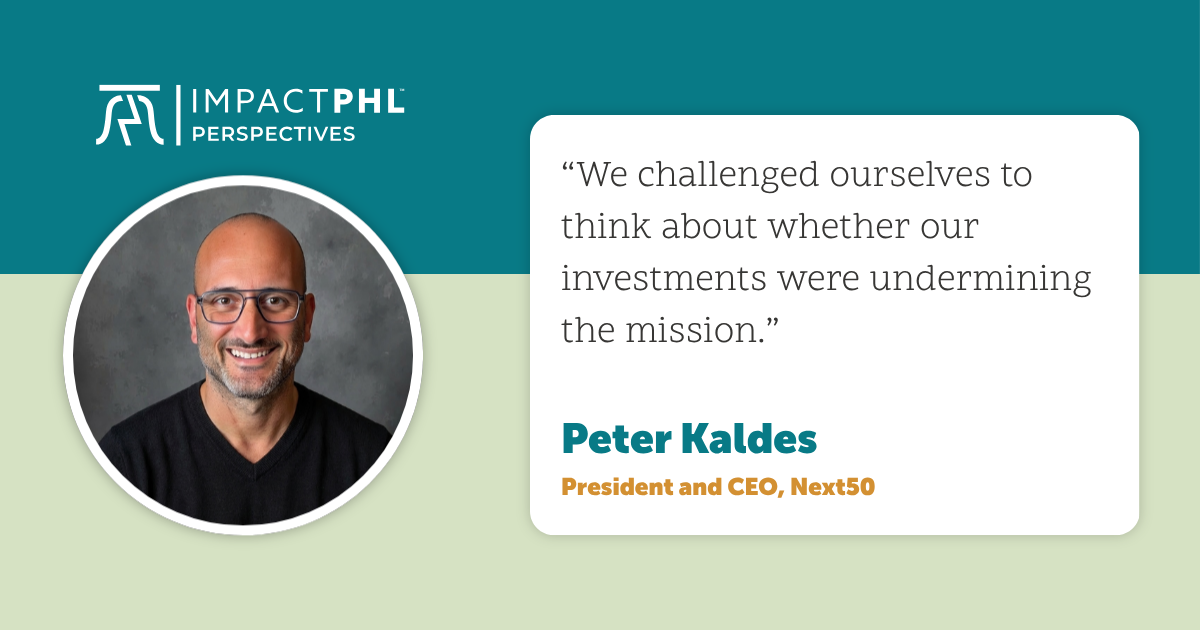
“We challenged ourselves to think about whether our investments were undermining the mission.”
“We challenged ourselves to think about whether our investments were undermining the mission,” says Peter Kaldes, president and CEO of Next50 and Lansdale, PA-native.
The question led the Denver-based private foundation to examine its entire $300 million-plus endowment through an aging lens. Today, nearly 85% of the portfolio is aligned with that approach. Along the way, Next50 helped develop a framework for evaluating investments based on how companies affect people as they age.
Seeing aging as an investment lens
Next50 focuses on aging and longevity across four areas: healthcare, economic security, social connection, and the built environment.
For Kaldes, that mission is personal.
“When I turn 80, I want the systems to be in place to support my successful aging,” he says. “Candidly, we don’t have them now.”
The demographic shift behind the work is already underway. Kaldes has noted that by 2034, adults 65 and older are projected to outnumber children under 18 for the first time in U.S. history. Eleven states, including Colorado, have already reached that point. In Philadelphia, he says, the population over 65 grew 24% over the past decade.
Still, conversations about aging tend to center on healthcare. Next50 saw a much wider set of questions involving where people live, how they work, the technology they use, and whether the economy is built to serve them.
“Our healthcare system, our education system, our workforce, all of it is built for 22-year-olds,” Kaldes has said. “Guess what? We’re running out of them.”
Next50 began asking what it would mean to apply that reality to its investments.
Putting the endowment through an aging screen
The foundation first developed its own Aging Investment Framework based on its work in aging, then issued an RFP for a financial institution that could turn that thinking into an investment methodology.
“We were trying to create a new way of looking at investing through the lens of aging,” Kaldes says.
JPMorgan won the opportunity to help Next50 put its money where its mouth is and invest in aging.
“JPMorgan rose to the top because they understood what we were trying to do,” Kaldes says.
JPMorgan used this treasure trove of research to develop a data-driven methodology for screening investments across public and private markets.
The bank already offered values-aligned investing strategies, but none focused on aging. Next50 supplied a primer on aging well in the form of an “enormous drive of science and policy materials that justified each of the four investment goals of the Aging Investment Framework,” Kaldes says. JPMorgan used this treasure trove of research to develop a data-driven methodology for screening investments across public and private markets. Next50 wanted the portfolio to pursue market-rate returns while applying an aging lens.
Some changes involved removing holdings. The foundation removed tobacco investments and began screening for corporate behavior that harms older adults, including age discrimination, Medicare fraud, and pension abuses.
Workforce practices became another factor. A company with unusually low representation of workers over 50, for example, could be treated as a laggard and screened out.
Next50 also began looking for companies whose products, services, or employment practices support people as they age.
Those public market screens initially brought about 70% of the portfolio into mission alignment. As Next50 began applying the framework to private market investments, its overall alignment grew to nearly 85%.
An aging investment might not look like one
One of Kaldes’ favorite examples of an aging-friendly investment is building product manufacturer CRH.
There is nothing overtly “aging” about aggregates or asphalt. But when Next50 and JPMorgan examined CRH’s workforce, they found that roughly 38% of its employees were over 50, which exceeds the national average.
“In our view, that makes the company a leader,” Kaldes says.
Other investments have a more obvious connection. Next50 has allocated capital to early-stage venture funds investing in age tech. Their portfolio companies include tools that help people find caregivers and transportation designed to accommodate wheelchairs and other mobility needs.
The foundation has also invested through funds backing menopause-focused femtech and technology for older adults with disabilities, including specialized wearables and assistive devices.
“Technology isn’t just for the young,” Kaldes says. “You can invest in age tech and help all of us as we age.”
The age-tech investments have also taken Next50 into territory that is less common for foundations: tech startups.
“Traditional venture capital can align with philanthropic capital to create investable, scalable opportunities to support all of us as we age.”
Kaldes sees room for philanthropic and venture capital to participate in the same emerging market. “Traditional venture capital can align with philanthropic capital to create investable, scalable opportunities to support all of us as we age,” he says.
Starting before the market is ready
Next50 did not find a ready-made universe of investments that fit neatly into an aging portfolio.
“We had to not be purists about this work,” Kaldes says.
The foundation had to educate investment managers and spend time examining companies whose connection to aging was easy to miss. It also had to accept that moving the full endowment would take time.
“What may not be an obvious investment up front can actually be good for aging,” Kaldes says.
That patience matters because the investment category itself is still developing. Kaldes hopes that growing interest will give fund managers and financial institutions a reason to create more ways to finance companies addressing the needs of older adults.
“In five or 10 years, we may have catalyzed more demand for creative kinds of financing for aging,” he says.
How to put your money where your values are
So, how can other foundations align their values with their money?
Next50’s process started with a simple comparison. The foundation knew what it wanted to accomplish through its grantmaking, then examined whether its investments were aligned in the same direction. That eventually gave the team a set of criteria it could use to evaluate the portfolio.
In other words, identify what matters to you, look closely at where your money is already invested, and ask whether the two line up.
Kaldes says foundations don’t need to invent a separate set of values for their investments. Their mission is the best starting point.
The organizations you already fund reveal what that mission looks like in practice and what kinds of business behaviors support or work against it. From there, bring those same questions to the rest of your capital.
Article by Ana Cvetkovic.