
Volume 96: Lights, Capital, Action
About ImpactPHL Perspectives:
ImpactPHL Perspectives is a multi-part content series that explores the many facets of the impact economy in Greater Philadelphia from the perspectives of its doers, movers, shakers, and agents of change. Each volume is written directly by a leader in this space to discuss best practices and share lessons learned while challenging our assumptions about financial and impact returns. For more thought leadership like this, check out the full catalog of ImpactPHL Perspectives.
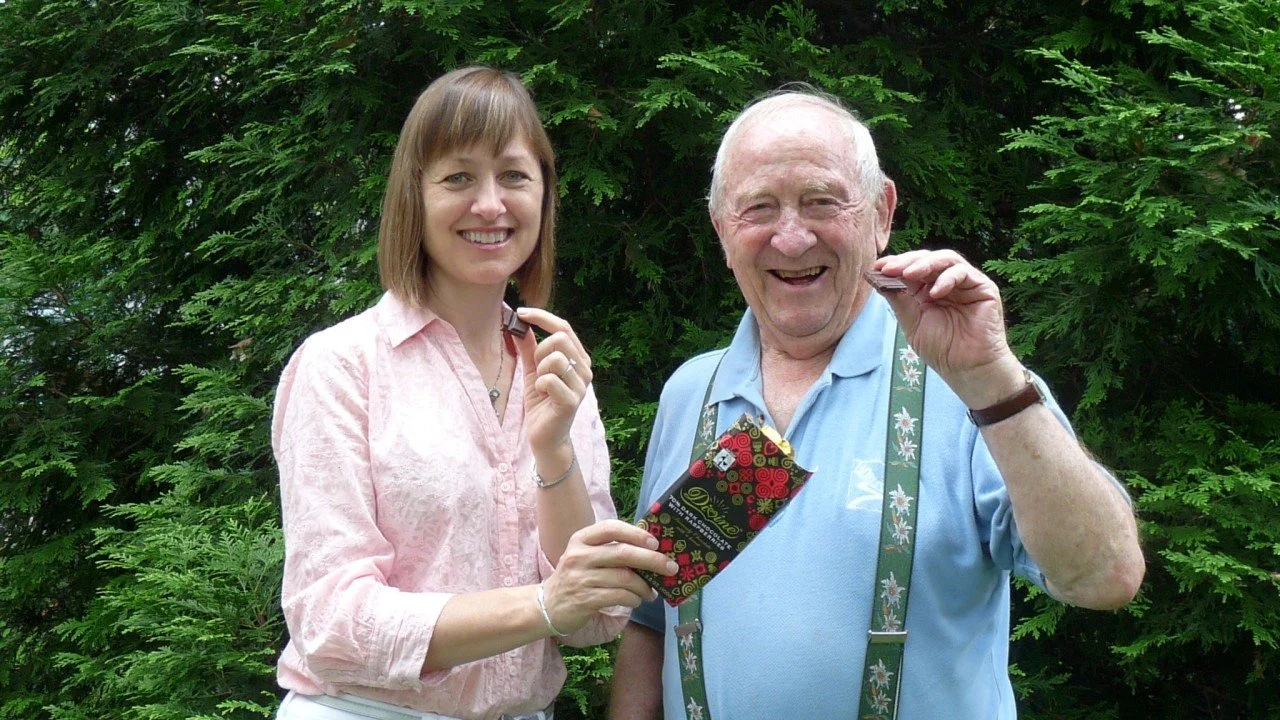
UnTours founder Hal Taussig and UnTours Foundation Co-CEO Elizabeth Killough share a moment as they enjoy a Divine Chocolate bar together.
Sarah Payne and Elizabeth Killough, UnTours Foundation
Back in the 1970s, our intrepid founder Hal Taussig took a six-month European sabbatical from teaching with his family. They had little money, so they worked along the way wherever they could find modest employment, including various monasteries. The experience was transformative, and Hal came home to Pennsylvania inspired to write the book Shoestring Sabbatical and build a company that would help other educators do the same: utilize time away from their work for meaningful travel.
But something unexpected happened. The people drawn to his fledgling business weren’t seeking sabbaticals. They were tourists: curious, motivated, and eager travelers, but not individuals ready or able to take months away from their lies to travel his way.
Though Hal initially clung to his original vision, he eventually recognized the mismatch. Letting go of the sabbatical model, he pivoted to meet what travelers truly wanted. That shift gave birth to UnTours. Stepping back did not dilute the mission; it clarified it. By releasing one assumption, Hal unlocked a model that was ahead of its time and has endured for decades.
“We then invite them to ask a more fundamental question, “How can we best advance our mission?”
Our fast and fun film trilogy of animated shorts invites foundations to do the same: take a breath, step back, and pivot as needed. Ask whether the structures they inherited still serve the missions they care about most. We then invite them to ask a more fundamental question, “How can we best advance our mission?” Too often, foundations instead begin with a narrower calculation: “How can we spend 5% of our assets this year on overhead and grants to advance our mission?” The IRS set that 5% minimum and precedent carried it forward, but very few foundations step back and wonder about how they can mobilize the other 95%. Ironically, foundations already know what it means to step back and get a full view. They require this of every potential grantee, who must present how all available resources (not just a portion) are being used to advance a mission.
Our first film, “Dollars That Make Sense,” spotlights the shadow over foundation endowments, that is, the 95% of assets that have been invested without consideration of the foundation’s mission. This age-old paradigm requires lots of stepping back to really see the forest through the trees – to fully grasp that, often, their 95% of assets are not at all connected to their missions.
One of many hurdles foundations run up against is how to identify private investments that match or complement their missions, and then how to perform due diligence on those investments. Our second film, “Money for Change,” highlights the Nelson Foundation of Philadelphia, and two of the private investments it selected for mission-aligned investing. This film’s goal is to de-mystify the process and offer an easy roadmap to follow.
“One of many hurdles foundations run up against is how to identify private investments that match or complement their missions.”
Our third film, “Bold Gold,” asks what it would look like to stop, drop, and roll up our sleeves to face our missions head-on. Aligning our investments with mission is an obvious and essential step, but for many of today’s challenges, alignment alone is not enough. The scale and speed of the crises we face demand far more immediate solutions than the 5% standard allows. We need more foundations to go boldly beyond the 5% for their giving, and to unlock their full endowment through mission-aligned investments.
Bold Gold also asks, “What about perpetuity?” Many assume it is sacred, but in reality, most founding documents can – and should – be revisited and changed when urgency demands it. Doing so is not a violation of fiduciary duty; it is an expression of it. Fiduciaries are responsible for keeping a foundation current, impactful, and firmly set on fulfilling their missions.
Hal pivoted and unlocked a working business model. This is the foundations’ moment to pivot and unlock more of the nearly $2 trillion in foundation endowments with solutions to problems we have been content to chip away at for far too long!
Written by Sarah Payne, Senior Director of Impact & Operations, & Elizabeth Killough, Co-CEO, of the UnTours Foundation. Born out of UnTours Travel, the world’s first B Corporation, the UnTours Foundation has been 100% mission aligned since its foundation in 1992. It uses its full endowment as a revolving loan fund investing in businesses locally and around the world that address social, economic, and environmental issues.